35 Must‑Have Tools for Your Photography Kit (Expert 2026 Guide)
Key Takeaways
- You will learn how to choose the right camera system by balancing sensor size, autofocus, stabilization, and lens ecosystem with your budget and goals.
- You will get a practical lens roadmap—standard zooms, primes, wide, telephoto, and specialty glass—with specific model picks across price points and brands.
- You will discover the accessories and lighting that prevent common shoot failures, including tripods, bags, flashes, filters, and power/memory essentials.
- You will get a complete post‑processing and backup workflow, from software and calibration to the 3‑2‑1 strategy using SSDs, NAS, and cloud services.
- You will find ready‑made genre checklists and budget kits so you can buy confidently now and upgrade strategically over time.
Photography is a dynamic art form that rewards precision, imagination, and the right tools. Whether you're a seasoned pro or just getting started, a thoughtful, well‑rounded kit helps you capture unforgettable moments consistently—and stress‑free. This expert photography gear guide upgrades and expands the essentials you already know, adds current recommendations, and gives you field‑tested tips to build a resilient system that grows with your skills.
How to Choose the Right Camera System
Start with your subjects, budget, and how you like to shoot. Then weigh the following factors before you commit to a system:
- Sensor size and image quality: Full‑frame excels in low light and dynamic range; APS‑C offers reach and value; Micro Four Thirds is compact with deep lens options.
- Autofocus and stabilization: Look for reliable subject/eye AF, tracking, and in‑body image stabilization (IBIS) for handheld sharpness and smoother video.
- Speed and video: Consider burst rate, buffer depth, 10‑bit video, log profiles, and heat management if you shoot action or hybrid photo/video.
- Lens ecosystem: Native lens availability, third‑party options (Sigma, Tamron, Viltrox), and adapter support affect both cost and creative breadth.
- Ergonomics and durability: Grip comfort, weather sealing, battery life, and viewfinder experience matter more than spec sheets suggest.
- Digital Single‑Lens Reflex (DSLR) Cameras DSLRs continue to be a popular choice due to their versatility and high image quality. When buying a DSLR, consider sensor size, resolution, and low‑light capability. The Canon EOS 5D Mark IV and Nikon D850 remain notable models for their robust build, dynamic range, and dependable autofocus. While many brands are prioritizing mirrorless development, DSLR bodies and F‑mount/EF‑mount lenses are still plentiful on the used market and can be outstanding values.
- Mirrorless Cameras Mirrorless cameras are compact, quiet, and increasingly dominant among working photographers. The Sony Alpha series and the Fujifilm X‑T4 are highly respected mirrorless cameras, and current standouts include the Sony a7 IV, Canon EOS R6 Mark II, Nikon Z6 II/Z8, Fujifilm X‑T5, OM System OM‑1, and Panasonic Lumix S5 II. Prioritize autofocus tracking, in‑body stabilization, rolling shutter control, and lens compatibility when you choose.
- Point‑and‑Shoot/Compact Cameras Compacts are ideal when you value portability or want a high‑quality backup to your main kit. The Sony RX100 series and Canon PowerShot G7 X line deliver strong performance from 1‑inch sensors in pocketable bodies—great for travel, family life, and discreet street work.
- Smart Buying: Sample Camera Kits by Budget
- Starter (great value): APS‑C mirrorless body with kit zoom; add a 50mm f/1.8 prime for portraits and low light.
- Enthusiast (balanced): Full‑frame mirrorless with 24–105mm f/4; add a 35mm or 85mm f/1.8 for subject separation.
- Pro/Hybrid (speed and depth): Full‑frame with fast AF and 10‑bit video; pair 24–70mm f/2.8 and 70–200mm f/2.8 for coverage.
- Lenses That Cover Every Situation Lenses shape your style. Think in focal length ranges, maximum aperture for light and bokeh, and stabilization for handheld work. Primes offer exceptional sharpness and speed; zooms add flexibility for events and travel.
- Standard Zoom Lens A versatile standard zoom handles everyday scenes, events, and travel. Canon's EF 24–70mm f/2.8L II USM and Nikon's AF‑S NIKKOR 24–70mm f/2.8E ED VR are proven classics with fast apertures and stellar optics. Modern mirrorless equivalents (e.g., 24–70mm f/2.8 or 24–105mm f/4) add stabilization and lighter builds; value picks include 28–75mm f/2.8 options from Tamron and Sigma.
- Prime Lens Primes are renowned for sharpness and low‑light performance. The Canon EF 50mm f/1.8 STM and Nikon AF‑S NIKKOR 50mm f/1.8G are affordable, lightweight, and beautifully sharp. Consider a 35mm for storytelling, an 85mm for portraits, or budget‑friendly third‑party primes (e.g., Viltrox, Sigma Contemporary) for exceptional value.
- Wide‑Angle Lens For landscapes, architecture, astro, and tight interiors, wide glass is essential. The Tamron 17–35mm f/2.8–4 Di OSD and Sigma 14mm f/1.8 DG HSM Art are popular, fast, and sharp choices. Mirrorless shooters can look at 16–35mm f/2.8 or f/4 options; APS‑C users may consider 10–18mm or 11–20mm ultrawides.
- Telephoto Lens For wildlife, sports, and isolating distant subjects, telephotos deliver reach and compression. The Canon EF 70–200mm f/2.8L IS III USM and Nikon AF‑S NIKKOR 70–200mm f/2.8E FL ED VR are workhorse choices. Lighter alternatives include 70–200mm f/4, 100–400mm for versatility, or 150–600mm super‑zooms when you need serious distance.
- Specialty Lenses to Expand Your Vision
- Macro (90–105mm): True 1:1 reproduction for nature, product, and food.
- Tilt‑shift: Perspective control for architecture or creative plane‑of‑focus effects.
- Fisheye: Bold, immersive views for sports, interiors, and artistic projects.
Essential Accessories That Save Your Shoot
- Tripod A stable tripod is critical for long exposures, low‑light scenes, timelapses, and precise framing. The Manfrotto MT190XPRO4 offers reliable stability with a versatile center column; the Joby GorillaPod is excellent for travel, vlogging, or uneven terrain. Consider carbon fiber for lighter carry, a quality ball head, and an L‑bracket for quick portrait/landscape swaps.
- Camera Bag Protect and organize your kit for daily shoots and air travel. The Think Tank Photo Airport Security V3.0 excels for flying with pro gear, while the Lowepro ProTactic 450 AW II balances access, protection, and modular expansion. For walk‑around comfort, try a sling or messenger; add rain covers and anti‑theft features for peace of mind.
- External Flash (Speedlight) On‑camera flash improves light in fast‑moving environments; off‑camera it becomes a creative tool. External units like the Godox V860II and Nikon SB‑5000 provide strong output and reliable TTL control. Pair with radio triggers (e.g., Godox XPro) to place lights anywhere; consider the Canon Speedlite 600EX II‑RT for Canon optical/radio systems.
- Filters
- Filters help control light and reflections in‑camera, reducing editing time:
- Circular Polarizer (CPL): Cuts glare, deepens skies, restores foliage color.
- Neutral Density (ND): Enables long exposures and motion blur; variable NDs are great for video.
- UV/Protection: Optional protection; use high‑quality, multi‑coated filters to avoid image degradation.
Power and Memory
- Spare batteries and a dual charger to keep shooting all day.
- Fast memory cards: SD UHS‑II, CFexpress, or XQD depending on your camera; carry multiple smaller cards for redundancy.
- High‑speed card reader for efficient imports.
- Field power: USB‑C PD power banks for cameras that support in‑body charging.
Cleaning and Protection
- Rocket blower, sensor swabs, and lens pens for routine maintenance.
- Microfiber cloths and a small brush for daily dust control.
- Rain covers and weather‑resistant straps for adverse conditions.
Comfort and Support
- Upgraded strap or harness for long days (e.g., Peak Design, BlackRapid).
- Monopod for sports and events to relieve arm strain.
- Remote shutter release/intervalometer for long exposures and timelapse.
Lighting That Flatters Any Subject
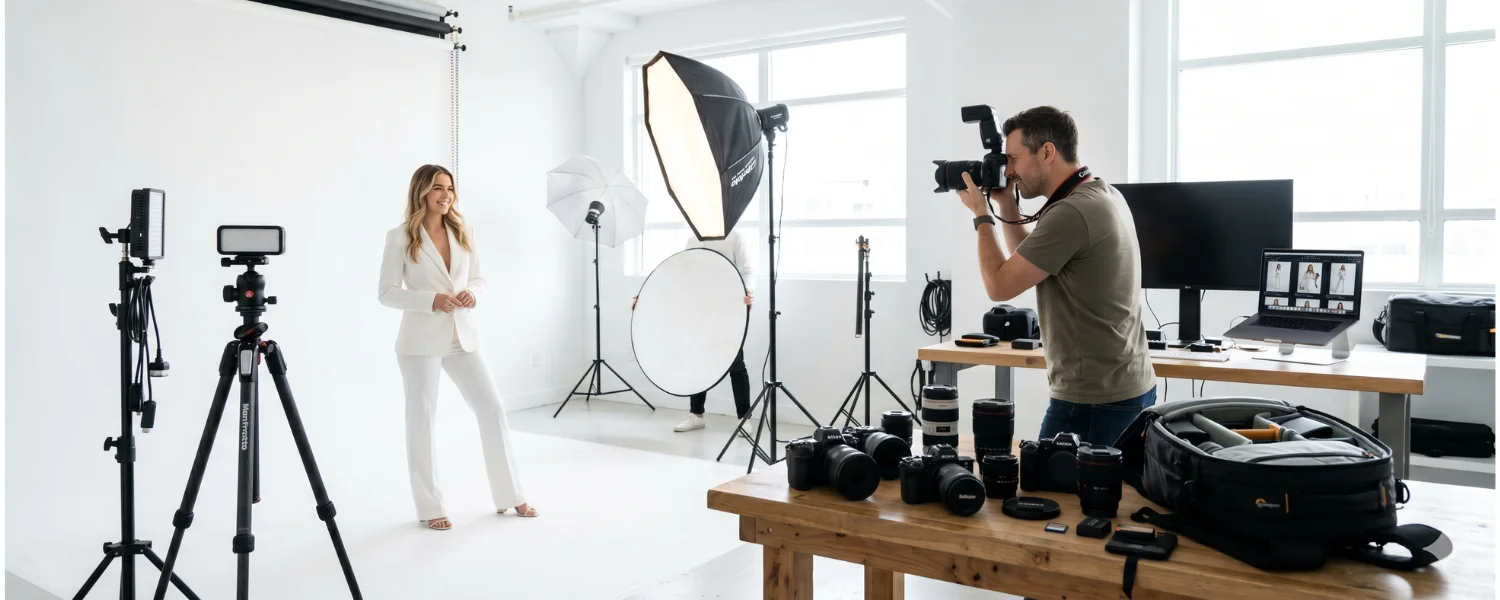
- Studio Lighting For portraits and products, strobes provide power, consistency, and crisp freeze. The Godox AD200Pro is a compact, versatile strobe; the Profoto B10 offers premium reliability and modifiers. Add sturdy light stands, softboxes, and grids for shape and control.
- Speedlights Speedlights are portable, quick to set up, and great on location. The Yongnuo YN560‑IV is a budget‑friendly manual option; the Canon Speedlite 600EX II‑RT integrates well with Canon systems. Bounce, diffuse, and get the flash off‑camera for professional results.
- Continuous LED Lighting LED panels and COB lights make learning light intuitive and simplify hybrid photo/video work. Look for adjustable color temperature, high CRI/TLCI, quiet cooling, and Bowens mount compatibility for softboxes.
- Reflectors and Diffusers A 5‑in‑1 reflector (gold, silver, white, black, translucent) shapes natural light for portraits, product, and macro. Large scrims and flags help tame harsh midday sun or control spill in tight spaces.
- Light Shaping Essentials
- Umbrellas: Fast setup and broad, soft light; great for beginners.
- Softboxes and octas: More directional control and pleasing catchlights.
- Grids and gels: Focus light and add color accents or corrections.
Post‑Processing, Color, and Backup
- Editing Software Adobe Lightroom and Photoshop remain industry standards for organizing and retouching. Capture One and DxO PhotoLab are excellent alternatives with standout color science and noise reduction. Also consider Affinity Photo, ON1 Photo RAW, and Topaz Photo AI for specialized tasks.
- Calibration Tools Calibrate your monitor to ensure accurate, consistent color. Reliable instruments include the X‑Rite ColorMunki and Datacolor SpyderX; newer options like the Calibrite ColorChecker Display series offer refined sensors and software.
- External Storage and Backup Back up your photographs regularly to protect your work. High‑capacity external drives like the WD My Passport and Seagate Backup Plus are solid choices; portable SSDs (Samsung T7/T9, SanDisk Extreme) are faster and more rugged for travel. Follow the 3‑2‑1 rule: three copies of your data, on two different media, with one off‑site (cloud options include Backblaze or similar). For teams or heavy shooters, a RAID‑enabled NAS (e.g., Synology) adds redundancy and collaboration.
- Workflow Tips That Save Hours
- Shoot RAW for maximum latitude; use sRGB for web and Adobe RGB/ProPhoto for print workflows.
- Consistent file naming, ratings, keywords, and collections make finding images easy later.
- Tether when precision matters (studio, product); a stable cable and a cable anchor prevent port damage.
- Invest in a calibrated, 10‑bit display and a hood to judge color and contrast reliably.
Printing with Confidence
Whether using a pro lab or a home printer, download ICC profiles for your paper, soft‑proof in your editor, and choose archival media for longevity. Matte papers flatter portraits; glossy and baryta papers maximize detail and contrast for landscapes and black‑and‑white.
Genre‑Based Gear Checklists
Portraits and Families
- Camera with reliable eye‑AF and natural skin tones.
- Lenses: 85mm or 50mm prime; 24–70mm for versatility.
- Lighting: One strobe or speedlight, 42–48″ softbox or umbrella, reflector.
- Extras: Seamless backdrop, V‑flat, tethering for studio review.
Landscapes and Travel Nature
- Wide zoom (16–35mm) and a sharp standard zoom or prime.
- Stable tripod, panoramic head optional.
- CPL and solid/grad NDs; weather‑sealed body and bag rain cover.
- Headlamp, spare batteries, microfiber for fieldwork.
Wildlife and Sports
- Fast AF body with deep buffer; consider blackout‑free EVF.
- Telephoto zoom (100–400mm, 150–600mm) or 300/400mm primes; monopod for support.
- High‑speed cards (CFexpress/SD UHS‑II) and protective rain gear.
- Camouflage cover or muted bag to stay unobtrusive.
Street and Everyday
- Compact mirrorless or high‑end compact (e.g., RX100/G7 X).
- 35mm or 40mm prime for storytelling perspective.
- Discreet sling bag, wrist strap, and extra battery.
Macro, Product, and Food
- 90–105mm macro lens and focusing rail for precision.
- Continuous LED or strobes with softboxes, scrims, and flags.
- Tethering setup and color checker for accurate reproduction.
Video and Hybrid Creators
- Body with 10‑bit codecs, log profiles, and IBIS.
- Variable ND, shotgun or lav mic, and on‑camera/LED key light.
- Gimbal or cage/rig with top handle; fast cards and spare SSDs.
Original Essentials: Upgraded with Field‑Tested Advice
Below are the core essentials from the original guide—now refined, updated, and expanded so you can buy with confidence.
1. Cameras (DSLR, Mirrorless, and Compact)
- DSLRs: Versatile with high image quality; consider sensor size, resolution, and low‑light capability. Standouts include the Canon EOS 5D Mark IV and Nikon D850.
- Mirrorless: Compact and powerful; evaluate autofocus speed, image stabilization, and lens compatibility. The Sony Alpha series and the Fujifilm X‑T4 are highly respected; also consider current bodies like the Sony a7 IV, Canon R6 Mark II, and Nikon Z6 II.
- Point‑and‑Shoot: Ideal for portability. The Sony RX100 and Canon PowerShot G7 X deliver advanced performance in small bodies.
2. Lenses (Core Focal Lengths First)
- Standard Zoom: Canon EF 24–70mm f/2.8L II USM and Nikon AF‑S NIKKOR 24–70mm f/2.8E ED VR are excellent; mirrorless 24–70mm f/2.8 or 24–105mm f/4 are great everyday choices.
- Prime Lens: For sharpness and low light, consider the Canon EF 50mm f/1.8 STM and Nikon AF‑S NIKKOR 50mm f/1.8G; add a 35mm or 85mm as your style evolves.
- Wide‑Angle: Landscape and architecture favorites include the Tamron 17–35mm f/2.8–4 Di OSD and Sigma 14mm f/1.8 DG HSM Art.
- Telephoto: For nature and sports, the Canon EF 70–200mm f/2.8L IS III USM and Nikon AF‑S NIKKOR 70–200mm f/2.8E FL ED VR are top picks, with 100–400mm or 150–600mm for extra reach.
3. Accessories (Small Items, Big Impact)
- Tripod: The Manfrotto MT190XPRO4 and Joby GorillaPod are solid, versatile options.
- Camera Bag: Protect and organize with the Think Tank Photo Airport Security V3.0 or Lowepro ProTactic 450 AW II.
- External Flash: Boost and shape light using reliable units like the Godox V860II and Nikon SB‑5000.
- Filters: Carry a CPL, ND set, and a protective UV where appropriate; buy quality glass to protect image integrity.
4. Lighting Equipment (Control Every Scene)
- Studio Lighting: The Godox AD200Pro and Profoto B10 are powerful, adaptable solutions with deep modifier ecosystems.
- Speedlights: Portable flashes like the Yongnuo YN560‑IV and Canon Speedlite 600EX II‑RT make on‑the‑go lighting easy.
- Reflectors: A 5‑in‑1 reflector adds polish by bouncing, diffusing, or blocking light.
5. Post‑Processing Tools (From Capture to Delivery)
- Editing Software: Adobe Lightroom and Photoshop are industry standards; Capture One and DxO PhotoLab are excellent alternatives.
- Calibration: Use devices like the X‑Rite ColorMunki and Datacolor SpyderX to ensure accurate color.
- External Storage: Back up regularly with high‑capacity drives such as WD My Passport or Seagate Backup Plus; add fast SSDs for working files.
Smart Buying, Care, and Security
- Maintenance: Update firmware, clean sensors/lenses, and inspect straps and plates.
- Insurance: Insure your kit; record serial numbers and keep purchase receipts.
- Security: Use discreet bags, luggage locks, and trackers; don't leave gear visible in cars.
Conclusion: Build a Kit That Fits Your Story
Constructing the ideal photography gear package is a personal journey shaped by your style, subjects, and budget. By investing in high‑quality cameras, lenses, accessories, lighting, and post‑processing tools—and by following a solid workflow and backup plan—you'll capture spectacular moments with confidence. Keep refining your kit as your interests evolve, and you'll stay inspired, nimble, and ready for any assignment or adventure.